Coastal Building Myths South Florida Contractors Debunk
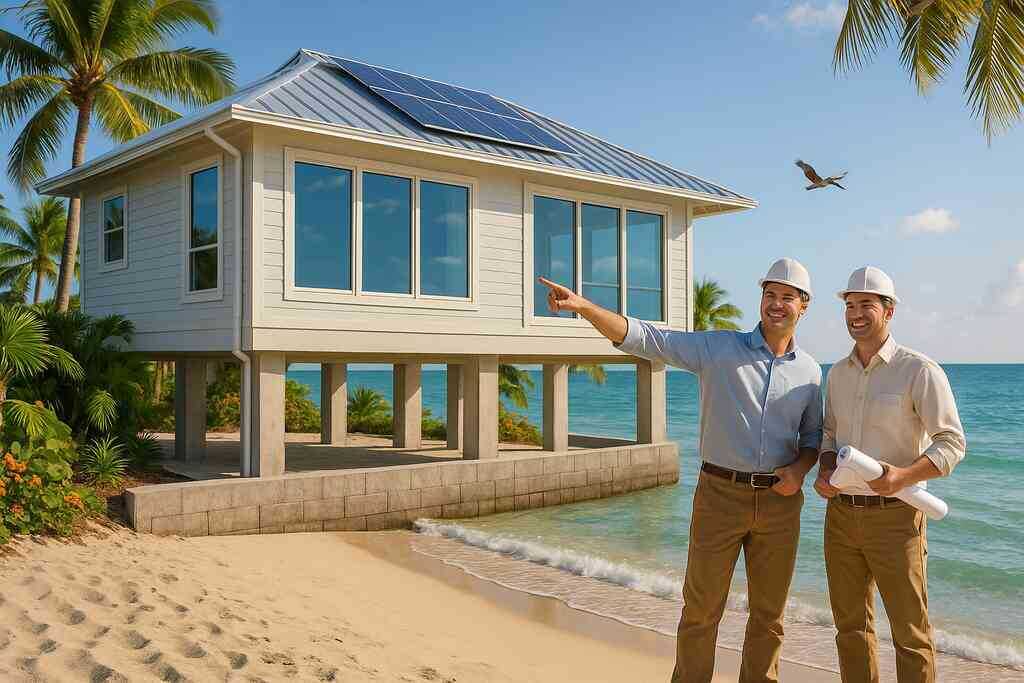
South Florida homeowners hear plenty of lore about what it takes to build near the Atlantic. This guide examines ten common coastal construction myths and explains how licensed contractors separate rumor from reality in 2026.
1. Myth: "Only concrete block survives a hurricane"
Reinforced concrete block (CMU) is reliable, but it is not the only storm-ready option. Modern wood‐frame walls strengthened with hurricane straps, impact sheathing, and continuous load paths can meet the same 180 mph wind ratings written into the current Florida Building Code. The key is engineering, not material bias.
2. Myth: "Stainless steel fasteners never corrode"
Salt air eventually attacks even premium stainless alloys. Contractors specify type 316 in splash zones, 304 farther inland, and use dielectric coatings where dissimilar metals touch. Scheduled inspections and occasional fastener replacement remain part of every long-term maintenance plan.
3. Myth: "Impact windows are enough—no need for shutters"
Approved impact glazing protects against wind-borne debris, yet shutters still add value. They lower cooling loads by blocking direct sun, shield the glass from sandblasting during tropical storms, and provide a secondary defense if a tree branch exceeds the window’s rated missile size. Experienced remodelers present both solutions and help owners weigh cost, insurance credits, and lifestyle.
4. Myth: "Raising a slab a foot or two solves all flood risk"
Elevating a structure does reduce flood premiums, but the target height must be based on the Federal Emergency Management Agency’s Base Flood Elevation plus freeboard adopted by the local municipality. In some Palm Beach neighborhoods that means four feet or more. A qualified general contractor reads the latest Digital Flood Insurance Rate Map, then confirms design elevations with a licensed surveyor before breaking ground.
5. Myth: "Spray foam traps moisture and causes mold"
Closed-cell spray foam actually lowers indoor humidity by sealing air leaks. Problems occur only when installers ignore dew-point calculations or block attic ventilation where it is still required by code. Certified insulation crews follow manufacturer-tested thickness charts and verify that the HVAC system incorporates fresh-air makeup to keep the building envelope healthy.
6. Myth: "Green roofs can’t handle hurricane winds"
Intensive vegetative roof assemblies are rare along the shoreline, but extensive low-profile systems (<6 inches of growing media) hold up well when designed with wind-uplift testing, proper edging, and drought-tolerant plants. Several municipal fire stations in Broward County have used them since 2020 without failure, demonstrating that sustainability and resilience are not mutually exclusive.
7. Myth: "Metal roofs always cost more than tile"
Upfront pricing depends on gauge, finish, and underlayment, but total life-cycle cost often tilts in favor of metal. Galvalume panels typically carry 40-year warranties and weigh far less than concrete tile, reducing structural loads. Faster installation speeds can shrink labor bills, while reflective coatings lower cooling expenses. A roofing estimator can run a side-by-side payback model so owners see beyond initial bids.
8. Myth: "Generator pads don’t need special reinforcement"
Portable units can sit on compacted gravel, yet whole-house generators exceeding 500 pounds should rest on reinforced slabs anchored to resist uplift and lateral forces. County inspectors now check for #5 rebar mats and tied‐down anchor bolts, lessons learned after units slid or overturned during Hurricane Ian. Electrical contractors coordinate with structural engineers to integrate these pads into permit documents.
9. Myth: "Stormwater rules only matter for commercial sites"
The South Florida Water Management District enforces detention volume even for single-family infill if the parcel triggers certain impervious surface thresholds. Proper grading swales and pervious paver driveways keep runoff on site, protecting neighbor properties and avoiding costly stop-work orders. Savvy builders submit drainage calculations with the initial permit package instead of treating them as an afterthought.
10. Myth: "Any licensed GC understands coastal details"
General licensure proves baseline competence, but coastal competence comes from ongoing education in wind, flood, and corrosion science. Leading firms attend Miami-Dade Product Control seminars, track ASTM salt-spray results, and maintain a database of past storm performance. During bidding, they provide project-specific wind design pressure charts and a written maintenance roadmap. Those deliverables distinguish rigorous professionals from paper qualifiers.
How contractors turn data into protection
South Florida’s construction codes evolve quickly. Experienced teams begin each project by reviewing the exact wind-borne-debris zone, exposure category, and flood zone overlay. They model shearwall locations in software, specify marine-grade hardware down to the washer, and stage materials to minimize on-site salt exposure. Field crews receive toolbox talks on the physics behind each detail, reinforcing a culture of evidence rather than superstition.
Aligning resilience with efficiency
Homeowners often worry that fortifying a house will spike energy bills or limit design freedom. In practice, airtight envelopes, high-performance glazing, and reflective roofs provide both storm tolerance and lower utility costs. The same muscle that keeps out wind-driven rain keeps conditioned air inside. When contractors propose packages—impact windows, sealed attics, variable-speed HVAC—they sequence the work so each layer complements the next, preventing redundant spending.
Practical steps for property owners
- Verify that your builder holds an active Florida General Contractor license and a history of coastal work.
- Ask for the project-specific wind design pressures and flood elevation benchmarks.
- Request documentation for all product approvals, including Miami-Dade or Florida Product Approval numbers.
- Review a five-year maintenance plan covering roof inspections, fastener checks, and sealant renewal.
- Schedule a pre-construction meeting with the structural engineer to clarify any remaining concerns.
Final takeaway
Coastal building success depends less on mythical silver bullets and more on disciplined adherence to codes, science, and local data. By challenging each rumor with verifiable facts, South Florida contractors deliver homes that stand firm, stay efficient, and protect long-term value—even when the next storm line appears on the horizon.
Top Ten Coastal Myths Debunked By South Florida Contractors


Comments
Post a Comment