Net Zero Home Costs: Build Smart with South Florida Experts
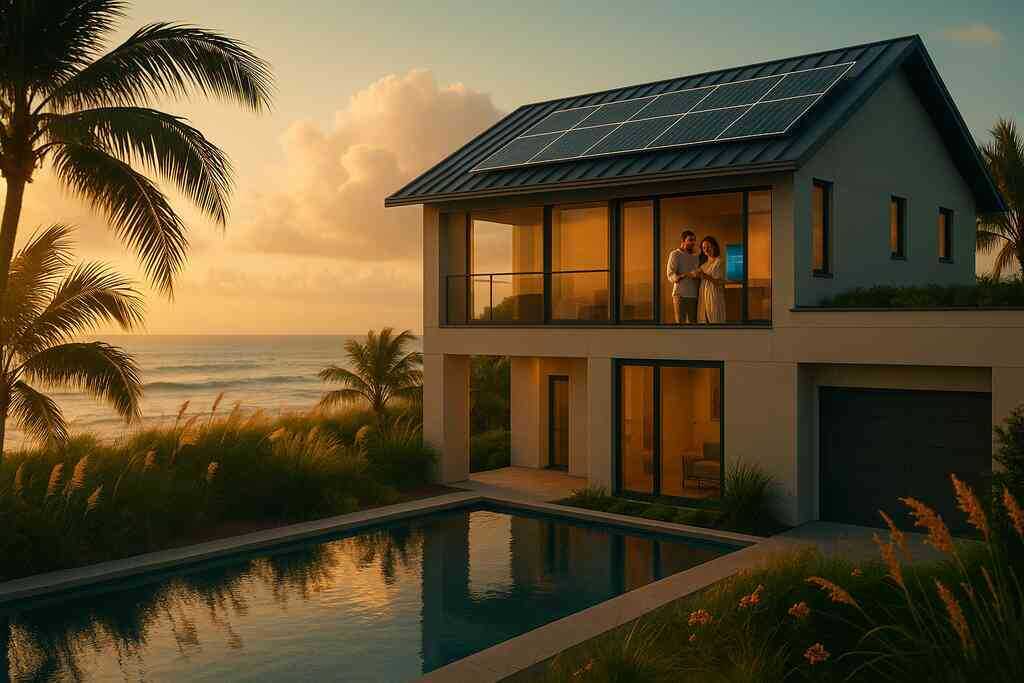
Net-Zero Living in South Florida
A net-zero home produces as much energy as it uses over the course of a year. In South Florida’s sunny, breezy climate, the goal is often easier—and less expensive—than many residents expect. This guide explains why local conditions work in your favor, how contractors design ultra-efficient envelopes and systems, and where the real cost savings appear.
1. Climate: The Hidden Ally
South Florida receives over 3 000 hours of high-quality sunlight each year, providing a near-constant fuel source for rooftop photovoltaics. Coastal breezes cool solar panels, nudging conversion efficiency a few percent higher than land-locked regions. Mild winters further reduce heating demand, allowing designers to focus on controlling summer heat and humidity. When cooling loads are lower, every other component—from ductwork size to battery capacity—shrinks in tandem, trimming both upfront and lifetime costs.
Turning heat and humidity into design opportunities
- Deep roof overhangs shade glass and walls.
- Light-colored, reflective roofing sheds infrared radiation and keeps attics cooler.
- Continuous air barriers block moist exterior air before it reaches insulation layers.
- Right-sized heat pumps paired with dedicated dehumidifiers remove latent moisture without excessive runtime, preserving indoor comfort while sipping electricity.
2. High-Performance Envelopes: Spending Once, Saving for Decades
A tight, well-insulated shell is the single most cost-effective step toward net zero. Rigid foam, blown cellulose, and spray-applied air sealants create a uniform thermal blanket that reduces temperature swing in walls and ceilings. Because fewer Btu leak in or out, mechanical equipment can often be scaled down 30 – 40 %. Smaller compressors cost less to buy, install, and maintain, offsetting part of the insulation premium from day one.
Typical envelope upgrades and approximate payback timelines
- Closed-cell spray foam under roof sheathing: 4–6 year payback from lower cooling bills and smaller air-handler sizing.
- Triple-pane, hurricane-rated windows with spectrally selective coatings: 7–9 year payback, extended by storm loss avoidance.
- Advanced weather-stripping and blower-door guided air sealing: often under 3 years because of minimal material cost and immediate load reduction.
3. Solar, Storage, and Load Matching
Once the envelope is dialed in, designers model remaining electric demand hour by hour. Array size is matched to that curve rather than chosen by rule of thumb, preventing costly over-sizing. A home that originally needed 10 kW of panels may drop to 6–7 kW after envelope and appliance upgrades—saving thousands in hardware and roof space.
Battery economics
Adding storage turns excess midday production into nighttime resilience and reduces the need for a larger array. In hurricane country, homeowners also value the ability to ride through grid outages without a noisy generator. When battery capacity is chosen to cover essential circuits—not the whole house—costs stay reasonable while comfort is preserved.
4. Demystifying the Cost Equation
Upfront investment for a net-zero ready shell and right-sized HVAC in a typical 2 400 ft² Boca Raton home runs 8 – 12 % above code-minimum construction. The solar-plus-storage package adds another 10 – 12 %. In practice, the combined premium often lands near 20 % compared with a conventional build.
Lifetime cash-flow picture
- Lower mortgage add-on: Financing an extra twenty percent at today’s green-mortgage rates adds roughly the same monthly payment as a mid-size car lease.
- Utility bill offset: Net-zero production can erase a $200 – $300 monthly electric bill, more than covering the financing bump.
- Maintenance savings: Smaller compressors and fewer run hours mean longer HVAC life and cheaper service contracts.
- Appreciation: Appraisers in Palm Beach and Broward Counties increasingly credit documented energy performance, boosting resale value well beyond construction premiums.
5. Local Incentives and Financing Tools
- Green mortgages: Many South Florida lenders now shave 0.125 – 0.250 percentage points off interest rates for homes achieving documented energy targets.
- Property-assessed clean energy (PACE): Repay efficiency and solar upgrades through property tax assessments, often with no money down.
- Utility net-metering: Grid-tied systems receive full retail credit for exported kWh, shortening solar payback to 6 – 8 years even before batteries.
- Insurance credits: Impact-rated openings and superior roof decking lower windstorm premiums, offsetting a portion of envelope costs.
6. Choosing the Right Team
Achieving true net zero requires close coordination among architects, energy modelers, and specialty trades. Look for contractors who:
- Provide blower-door tests before drywall to verify airtightness.
- Use room-by-room HVAC load calculations (Manual J) to size equipment, not rules of thumb.
- Offer solar design in parallel with structural and roofing plans, eliminating awkward retrofits.
- Supply third-party verification—such as HERS scores or Department of Energy Zero Energy Ready Home documentation—so performance claims are backed by data.
7. Step-by-Step Roadmap
- Define performance goals. Decide whether the target is net-zero ready (no solar yet) or full net zero from day one.
- Energy model early. A preliminary model during schematic design clarifies envelope R-values, glazing ratios, and HVAC sizing.
- Prioritize envelope. Lock in insulation, air barrier, and window packages before pursuing mechanical quotes.
- Integrate solar and storage. Coordinate conduit paths, roof truss layout, and battery location at the same time structural drawings are finalized.
- Commission and verify. Post-construction testing ensures the building meets design intent, unlocking rebates and long-term savings.
8. The Bottom Line
In 2026, building or renovating to net-zero performance in South Florida is no longer an experimental exercise. Thanks to abundant sunshine, mild winters, and a growing pool of skilled contractors, the incremental cost carries a clear, quick payback—often shorter than the time many owners plan to live in their home. By prioritizing envelope efficiency, right-sizing systems, and integrating solar at the design stage, homeowners can secure predictable energy bills, stronger resale value, and storm-ready resilience without sacrificing architectural style.
Planning a project today means locking in low operational costs for decades, even as utility rates climb. The path is proven; the climate is ideal. All that remains is choosing a team equipped to deliver on the promise of true net-zero living.
Net Zero Home Costs With South Florida Contractors Boca


Comments
Post a Comment